

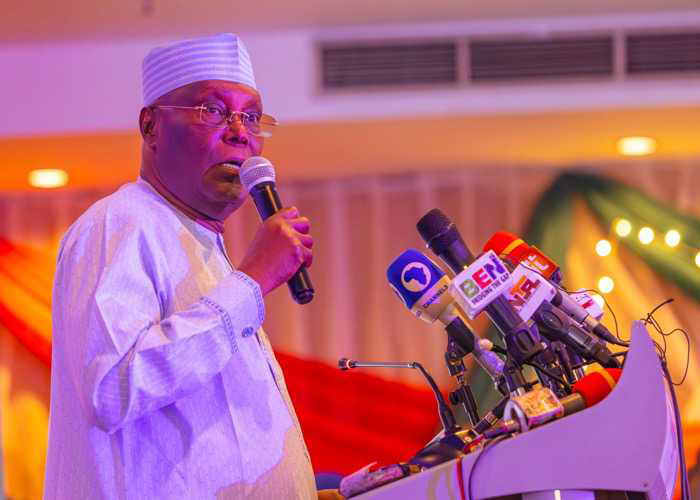
Former Vice President Atiku Abubakar has accused President Bola Ahmed Tinubu’s administration of hypocrisy over its handling of petroleum-sector interventions, arguing that the government cannot claim to have abolished fuel subsidy while providing tax credits, fiscal concessions and other incentives to major oil and gas investors.
Atiku made the accusation in a statement issued on Sunday in Abuja by his Senior Special Assistant on Public Communication, Phrank Shaibu.
He argued that despite the declaration of subsidy removal, Nigerians continued to bear the financial consequences of government interventions in the petroleum sector through various forms of under-recovery, shortfalls and energy-security spending.
According to him, the issue has become more significant following the unveiling of his Atiku Economic Recovery Plan (AERP), which proposes a targeted and transparent intervention to cushion households from high energy costs while promoting domestic refining and reducing dependence on imported petroleum products.
Atiku said the administration appeared to reject government intervention when it was intended to protect ordinary Nigerians but embraced it when major investors stood to benefit.
He pointed to incentives provided to investors in deep offshore oil and gas projects, including production tax credits and other fiscal measures, as evidence that government intervention remains part of the administration’s economic policy.
The former Vice President questioned why similar interventions designed to ease the burden of high energy costs on households should be considered unacceptable.
He also cited figures from NNPC’s audited financial statements, claiming that the company recorded about ₦4.84 trillion in energy-security expenses and related shortfalls in 2023, while approximately ₦7.13 trillion was recorded under energy-security expenses in its 2024 audited accounts.
Atiku said NNPC had explained that part of the expenditure resulted from differences between the exchange rate used to determine regulated PMS ex-coastal prices and the prevailing exchange rate when import obligations were settled.
He therefore challenged the Federal Government to clearly explain the distinction between subsidy, under-recovery, shortfall and energy-security expenditure whenever public funds are used to bridge the gap between the economic cost of petroleum products and their selling price.
According to him, changing the terminology does not alter the financial burden borne by the public.
Atiku argued that the fundamental question should be whether government intervention is being used primarily to protect corporate investments or to shield citizens from severe economic hardship.
He said the Tinubu administration could not provide fiscal incentives aimed at reducing investment risks for petroleum companies while dismissing targeted measures to reduce energy costs for households as economically unsound.
The former Vice President maintained that workers, traders, farmers and families had been left to absorb the impact of rising costs while investors continued to receive various forms of government support.
He described this approach as an “upside-down economy,” arguing that economic reforms should not impose disproportionate hardship on ordinary Nigerians while offering substantial protection to corporate interests.
Atiku stressed that his proposed intervention under the AERP should not be confused with the previous fuel subsidy regime, which he described as opaque and susceptible to abuse.
He said his proposal would be targeted, capped, transparently budgeted and independently audited, with a clear exit strategy.
The plan, according to him, would also focus on expanding domestic refining capacity, improving competition, strengthening mass transportation and restoring household purchasing power.
Atiku further called on the Federal Government to disclose the beneficiaries and financial implications of major petroleum-sector tax credits, concessions, remissions and other incentives.
He said Nigerians deserved to know the value of revenue surrendered through such incentives, the investments delivered in return and whether Nigerian investors had equal access to comparable fiscal benefits.
He argued that government intervention should not become acceptable only when corporations benefit from it while measures designed to protect citizens are dismissed as economically irresponsible.
Atiku said the ultimate measure of economic reform should be whether Nigerians are becoming better off, businesses are becoming more productive, jobs are being created and household incomes are sufficient to meet basic living expenses.
The former Vice President concluded that the government should not demand widespread sacrifice from citizens while extending fiscal concessions to investors and describing the resulting hardship as the unavoidable cost of reform.
Comments
Join the conversation and share your thoughts.
Login Required
Please login to join the conversation and post a comment.
No comments yet
Be the first to share your thoughts on this story.