

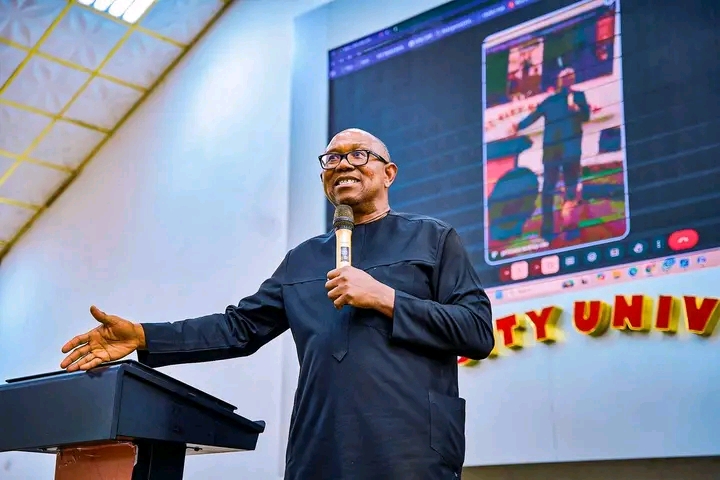
ENUGU, Nigeria — Former presidential candidate, Peter Obi, has called on the Federal Government to urgently prioritise investment in education, warning that Nigeria risks falling further behind in global development if decisive action is not taken.
Obi made this known on Tuesday while delivering a lecture at Coal City University, Enugu, titled “Repositioning Nigeria’s Education Sector for National Growth and Global Competitiveness.”
He commended the Vice-Chancellor and management of the institution for their commitment to academic excellence and for fostering meaningful national dialogue on critical development issues.
According to Obi, no nation can rise above the quality of its education system, stressing that Nigeria’s current socio-economic challenges reflect years of underinvestment in human capital development.
Citing development indicators, he noted that Nigeria’s Human Development Index (HDI) remains low at approximately 0.548, while youth unemployment and underemployment exceed 30 percent. He added that life expectancy in the country hovers between 50 and 55 years, with literacy levels estimated between 59 and 65 percent.
“These indicators clearly point to deep structural weaknesses in our development trajectory,” Obi said.
He further highlighted that Nigeria allocates less than 10 percent of its national budget to education, significantly below the global benchmark of 15 to 20 percent recommended by bodies such as UNESCO.
Drawing comparisons with countries like Indonesia, Egypt, and South Africa, Obi noted that these nations have achieved higher Human Development Index ratings — between 0.72 and 0.75 — through sustained investments in education, healthcare, and human capital.
“The difference is not in talent, but in priority and policy consistency,” he emphasised.
Obi called for a comprehensive review of Nigeria’s education funding model, advocating stronger public-private partnerships and more inclusive policies that recognise the contributions of private institutions.
He questioned the exclusion of private universities from intervention programmes such as Tertiary Education Trust Fund (TETFund), arguing that they play a critical role in expanding access to quality education and building national capacity.
“Education is not charity; it is the foundation of national growth and the gateway to global competitiveness,” Obi stated.
He concluded that with sustained investment in education and a deliberate focus on human capital development, Nigeria can reposition itself for long-term prosperity.
Kwale Post reports that stakeholders across the education sector have continued to advocate increased funding and policy reforms to address the country’s growing educational challenges.
Comments
Join the conversation and share your thoughts.
Login Required
Please login to join the conversation and post a comment.
No comments yet
Be the first to share your thoughts on this story.